Slow Coffee: Why Hanoi Brews Robusta and Refuses to Hurry
A Hanoi guide on Vietnamese coffee culture: why robusta rules, how the phin filter works, and where egg, coconut and salt coffee fit in a city that drinks slow.
 By Mai Trần, Hanoi food tour guide and culinary specialist

My mornings start with a sound: the tick of coffee dripping through a metal phin onto condensed milk, one drop at a time, while the street outside does everything at full speed. That contrast is the whole culture in miniature. Hanoi is a city that walks fast, cooks fast, and drinks coffee slower than almost anywhere on earth.
I take a lot of visitors to their first phin, and the reaction follows a script. First: impatience, because the filter takes minutes and the glass looks tiny. Then the first sip, and the eyebrows go up, because Vietnamese coffee does not taste like what they call coffee at home. It is darker, thicker, almost chocolate-bitter, and it is built on a different bean entirely. Understanding that bean explains nearly everything else on the menu.
Why is Vietnamese coffee mostly robusta?
Because Vietnam is the world's robusta powerhouse. Of the roughly 31 million 60-kg bags forecast for the 2025/26 season, about 30 million are robusta and only 1 million arabica. Robusta is stronger, more bitter and more caffeinated than arabica, and the whole Hanoi coffee style, condensed milk included, evolved to partner it.
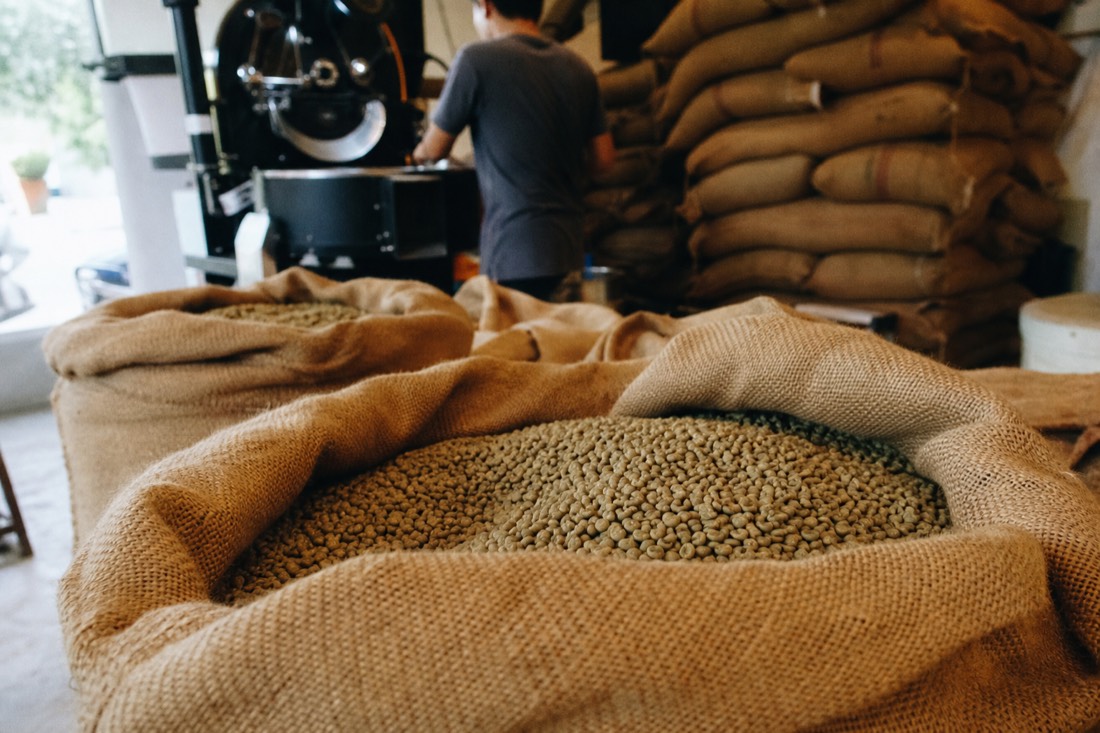
The numbers behind the cup are staggering at the moment. Coffee has become one of the country's headline exports, and the recent robusta price surge turned a big year into a record one.
| Vietnam coffee, the current numbers | Figure |
|---|---|
| 2025/26 production forecast | ~31 million 60-kg bags, up from 29 million |
| Of which robusta | ~30 million bags |
| Of which arabica | ~1 million bags |
| 2025 export volume | ~1.59 million tonnes |
| 2025 export revenue | Over US$8.92 billion, up 58.8% in value year on year |
I watch that record year play out at street level, in ways no export chart shows. Vendors talk about bean prices the way farmers talk about rain. The roasting smell that drifts through certain Old Quarter mornings has become, to my nose, the smell of a national industry having its moment. And my guests arrive already primed, because robusta's rehabilitation has reached their cafes at home, where the bean long dismissed as filler is suddenly interesting.
Why does a bean ratio matter to your breakfast? Because robusta's intensity is the reason the classic drinks are built the way they are. Straight black, ca phe den, is a serious statement. Cut with sweetened condensed milk, ca phe sua, it becomes the national default: the bitterness and the sweetness locked in balance. Almost every famous Vietnamese coffee drink is some new answer to the same question, what else can stand up to this bean.
How does the phin change the way you drink?
Mechanically and psychologically. The phin is a small metal gravity filter that sits on your glass and drips the brew through over several unhurried minutes, no machine, no barista flourish. You cannot rush it, so the wait becomes the point: coffee as a seat and a pause, not a takeaway cup.
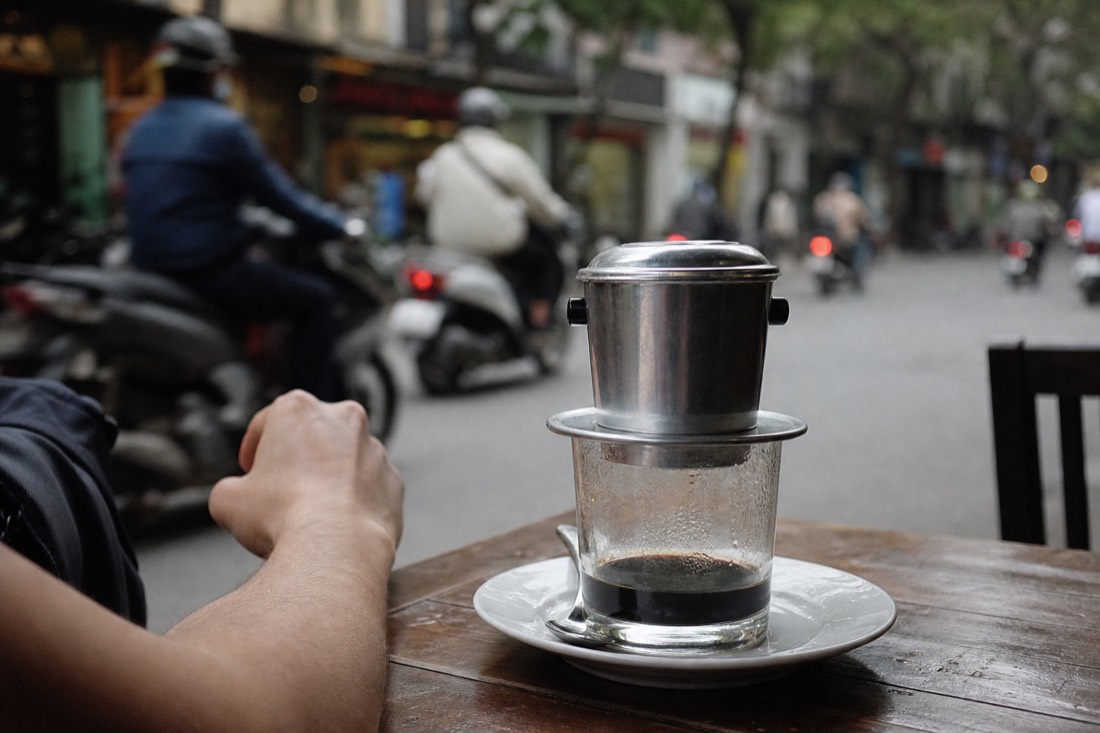
The mechanics are worth knowing before your first one arrives. The phin is a brewing chamber, a perforated press disc and a lid, sitting directly on your glass. Grounds go in, hot water goes on top, gravity does the rest at its own pace, and the lid flips over to become a saucer for the dripping filter when you finally lift it off. There is no crema, no steam wand, no theatre beyond patience. My guests who time it get restless around minute three; by their third morning in Hanoi they have stopped timing it, which I consider the trip's quiet victory.
Watch a Hanoi cafe at 8 AM and you will see the phin's real product, which is time. People sit. They watch the street. The drip finishes and they stir and sit some more. The device itself is having a moment too: a Hanoi barista, Vu Dinh Tu, redesigned the traditional filter as the colorful Phinoi, debuted it at World of Coffee Jakarta in May 2025, and sold out. The old tool is becoming an export in its own right, which pleases me more than it probably should.
What are all the Hanoi coffee variations?
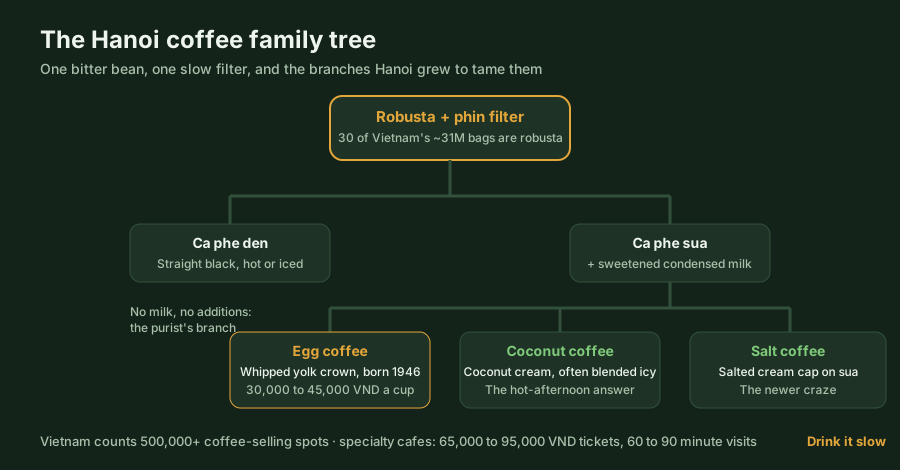
One trunk, many branches. Start from strong phin-brewed robusta, add sweetened condensed milk for ca phe sua, then follow the substitutions: whipped egg yolk for egg coffee, coconut cream for coconut coffee, a salted cream cap for salt coffee. Each was invented to soften the same bitter base a different way.
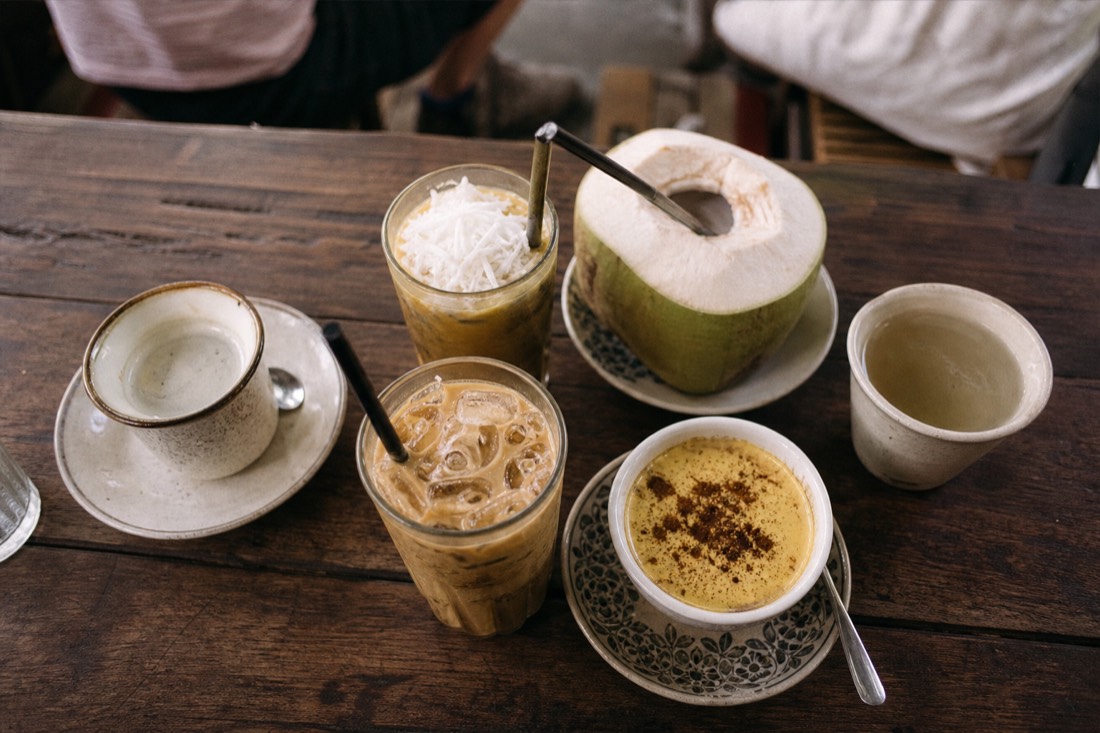
Egg coffee is the branch with the birth certificate: invented in 1946 by Nguyen Van Giang during a milk shortage, a story Vietcetera's history traces in full, and still served by his family at Cafe Giang on Nguyen Huu Huan. I wrote the full pilgrimage notes in the egg coffee guide, and the drink anchors an entire hour of my week, usually at a track-side table like the one in my Train Street egg coffee hour.
| Drink | The build | When Hanoi drinks it |
|---|---|---|
| Ca phe den | Phin robusta, straight, hot or iced | Morning, taken seriously |
| Ca phe sua | Robusta over sweetened condensed milk | The all-day default |
| Egg coffee (ca phe trung) | Whipped egg yolk and condensed milk on hot robusta, 30,000 to 45,000 VND a cup | Afternoon, as dessert |
| Coconut coffee | Coconut cream, often blended icy, over robusta | Hot afternoons |
| Salt coffee | Lightly salted cream cap on condensed-milk coffee | The newer craze, any hour |
One practical note for the iced versions, since guests ask me daily: ice in reputable, busy cafes is factory-made and fine for most travellers, but the standard CDC food and water guidance counsels care with ice generally, so the cautious move on a sensitive stomach is drinking your first rounds hot. The hot versions are the originals anyway.
Where does Hanoi actually drink?
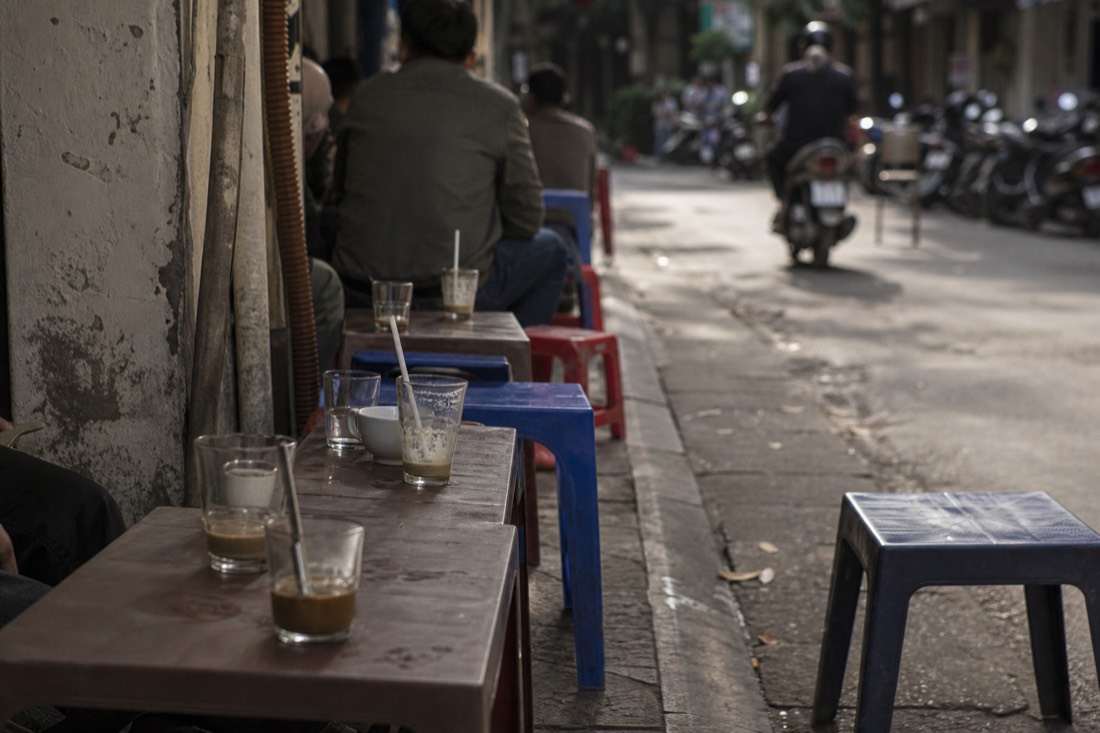
Everywhere, at half a million points of sale. Vietnam counts more than 500,000 coffee-selling spots, from pavement stools to chains like Highlands Coffee, at roughly 855 to 900 outlets, and Phuc Long at about 237. In the specialty cafes, the median ticket runs 65,000 to 95,000 VND and people linger 60 to 90 minutes.
| Cafe type | Median ticket (VND) | Typical linger |
|---|---|---|
| Specialty and third-wave cafes | 65,000 to 95,000 | 60 to 90 minutes |
| Modern chains | 55,000 to 75,000 | 35 to 55 minutes |
| Old-school family cafes and pavement spots | Egg coffee at 30,000 to 45,000 as the marker | As long as you like |
Look at those dwell times again, because they are the cultural data hiding in market research. Even in the modern chains, people sit the better part of an hour. Coffee here is not fuel between appointments; it is the appointment. The old family cafes of the Quarter, the ones I map in the Old Quarter food guide, simply do not acknowledge the concept of turning a table. Where a cup fits in a day's eating budget, alongside everything else, is charted in the Hanoi food prices guide.
My own map of the city runs on cafes the way other people's run on landmarks. There is the pavement spot where I take five minutes between morning groups, all tiny stools and traffic view. There is the old house cafe where I go to write, up a staircase no tourist would try without a tip-off, where the owner has poured the same slow glasses for decades. And there are the new specialty rooms full of students and laptops, pulling single-origin Vietnamese beans with real seriousness. Visitors sometimes ask me which one is the authentic Hanoi cafe. All of them. The culture is not a museum; it is 500,000 points of sale arguing about the same bean.
How do you learn the whole system in one afternoon?
Taste it side by side. Cafe-hopping teaches you one drink per sitting, over days. A guided tasting compresses the map: the Hanoi Coffee Experience runs six brews, nine recipes and three coffee-liquor tastings in about three hours, with egg and coconut coffee both on the bench.
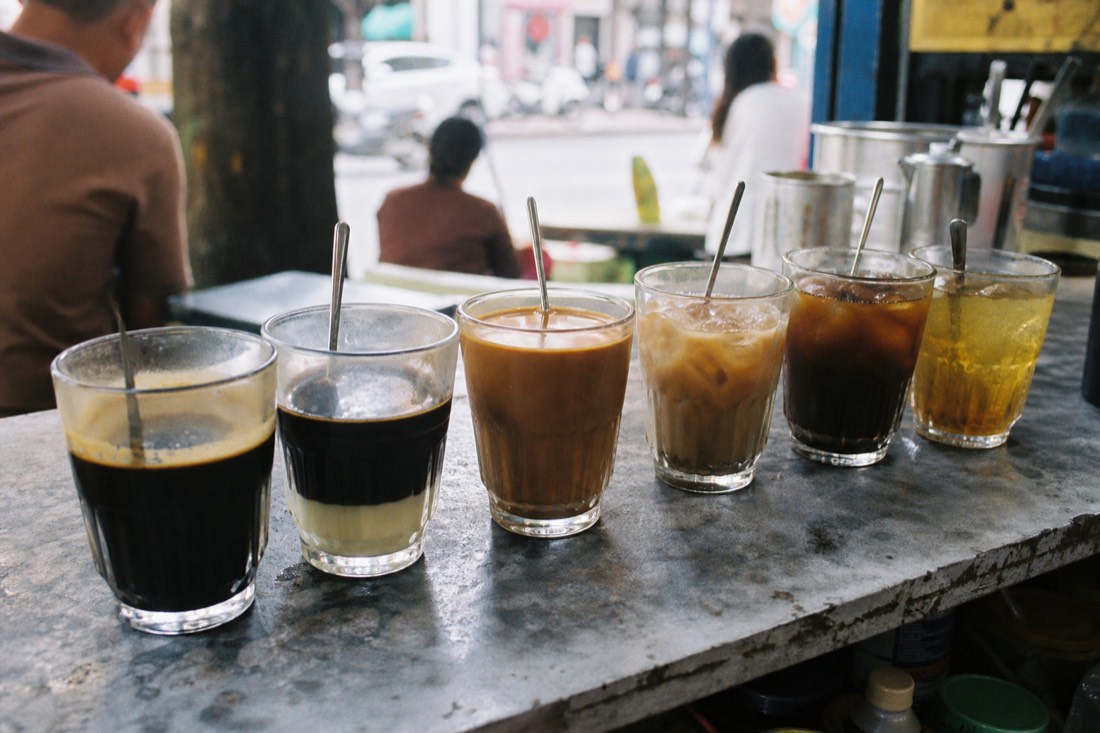
Which drinks you will love, which are souvenirs, how the phin behaves, why the same bean tastes different in five glasses: those are useful questions to bring to a coffee workshop.
Then let the culture slow you down properly. Pick a pavement cafe, order a ca phe sua, and give it the full Hanoi treatment: no phone for the first ten minutes, just the drip and the street. Somewhere in that tick-tick-tick of the phin is the answer to why my city, which hurries at everything else, decided a century ago that coffee would be the exception. I have drunk it this way my whole life, and I am still not bored of the wait.
Your next Hanoi experience
Check your date before planning the rest of the day
Hanoi six-brew coffee workshop
Make and compare phin, egg and coconut coffee with an English-speaking coffee host.
Three hours; ingredients, equipment and snacks included. Travel to the Hoang Hoa Tham meeting point yourself. Some tastings contain alcohol; confirm alternatives and child participation.
An editorial starting point. Confirm your party’s requirements with the operator.
Choose a date to see scheduled departures. Final availability and price are confirmed on Viator.
No verified option fits those requirements. Adjust your choices or reset to explore the general recommendations.
Compare options, fit your schedule & check your budget
Hanoi six-brew coffee workshop · 3h. Make and compare phin, egg and coconut coffee with an English-speaking coffee host. Three hours; ingredients, equipment and snacks included. Travel to the Hoang Hoa Tham meeting point yourself. Some tastings contain alcohol; confirm alternatives and child participation.
Rose Kitchen market and cooking class · 4.5h. Shop at a local market, cook a selected Vietnamese menu and share the meal in a garden-villa kitchen. Allow 4–4.5 hours depending on option. Menu choices vary; pho or bun cha must be selected. Check pickup option. Vegan menu available by arrangement.