Market to Table: What a Hanoi Cooking Class Day Really Teaches You
A Hanoi guide on the market-to-table cooking day: what you shop for, the dishes you cook, what foreign cooks get wrong at the wok, and what finally clicks.
 By Mai Trần, Hanoi food tour guide and culinary specialist

There is a moment in every wet market when a first-time visitor stops walking. Usually it is the banana flower that does it, that purple torpedo sitting on a vegetable stall, or the herb table with its dozen bundles of leaves that all read as "mint" to an untrained eye and are all different plants. I shop these markets for my own kitchen, and I bring travellers through them, and the questions never change. What is that. How do you cook it. Why does it smell like that.
A market-to-table cooking class exists to answer exactly those questions with your own hands, and Hanoi's most popular version of it runs through Rose Kitchen. I have not cooked in their villa myself. But I know the dishes on their bench the way I know my own knives, my guests report back to me constantly, and the gap between what foreign cooks expect and what actually happens at the chopping board is my favourite subject in food.
What do you cook in a Hanoi cooking class?
Rose Kitchen's published sample menu runs banana flower salad to start, then two mains, fried spring rolls and barbecued pork with rice vermicelli and dipping sauce, and egg coffee for dessert. Every dish has a vegan or vegetarian alternative, and the roughly four-hour session opens with a market visit to buy the ingredients.
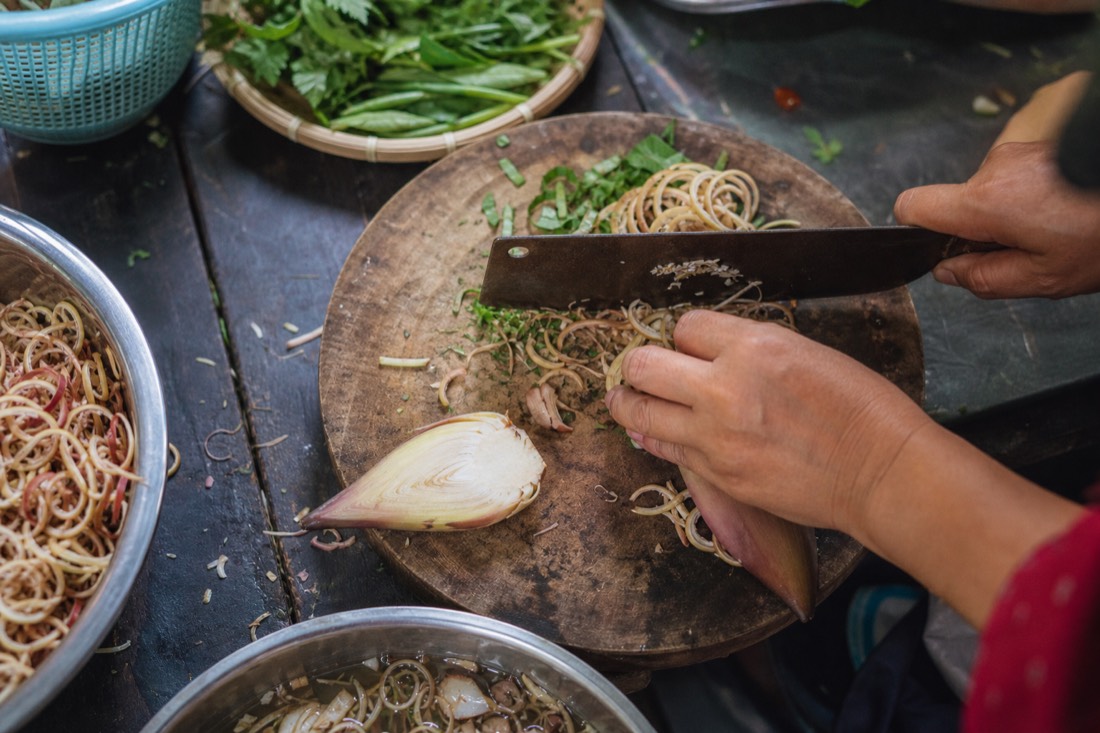
Read that menu again with a guide's eye, because it is quietly a syllabus of northern technique. Nothing on it is restaurant showing-off; all of it is what Hanoi households actually make, chosen so that each dish hands you one transferable skill.
| Dish on the sample menu | The skill it actually teaches |
|---|---|
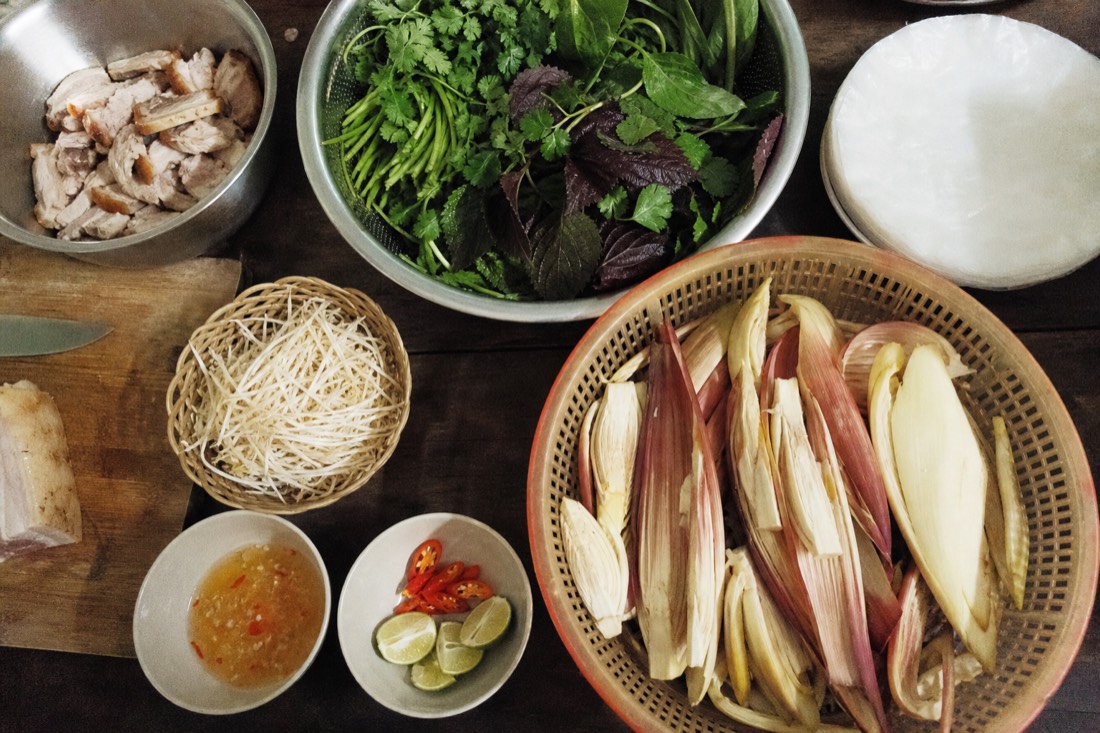
| Banana flower salad | Fine knife work, keeping the flower from browning, balancing lime, sugar and fish sauce |
| Fried spring rolls | Rolling tight without tearing, and frying to glass-crisp rather than greasy |
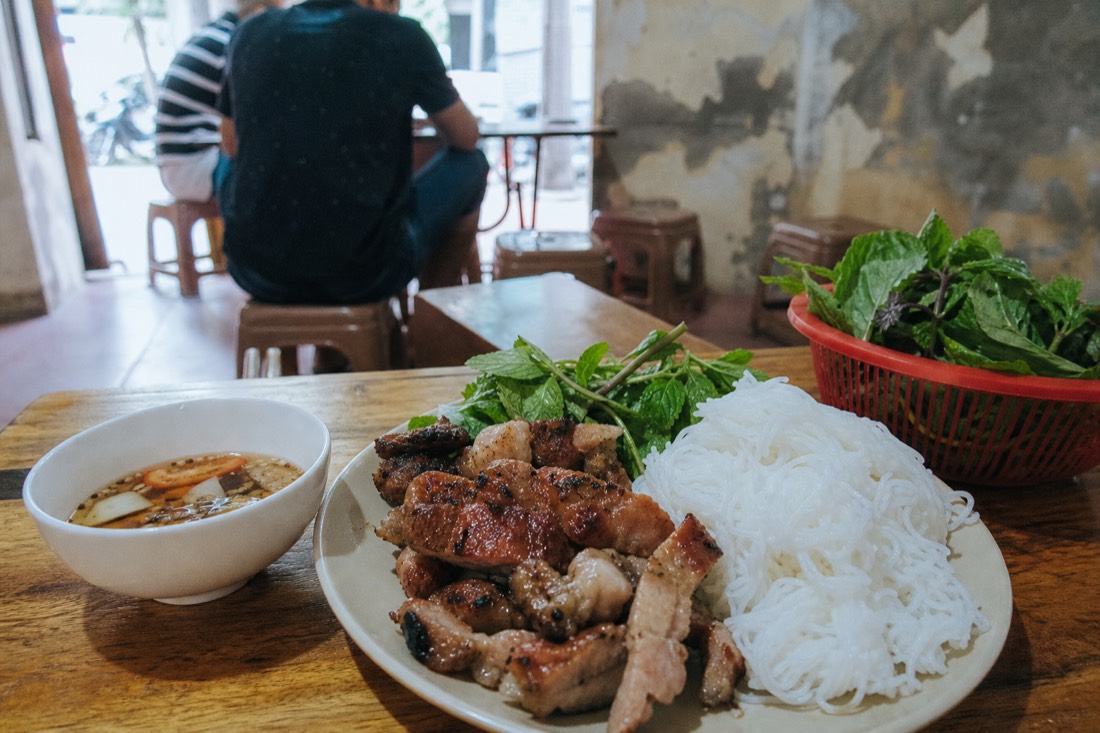
| BBQ pork with vermicelli and dipping sauce | Charcoal-style grilling and the sweet-sour-salty dipping sauce that carries the dish |
| Egg coffee | Whipping yolk and condensed milk into a foam that sits on the coffee |
That pork-and-vermicelli main is, of course, the same family as bun cha, the dish I have spent years obsessing over, and the dessert is Hanoi's own invention, whose full story sits in the egg coffee guide. Cooking them yourself changes how you order both for the rest of your trip.
How does the market-to-table day run?
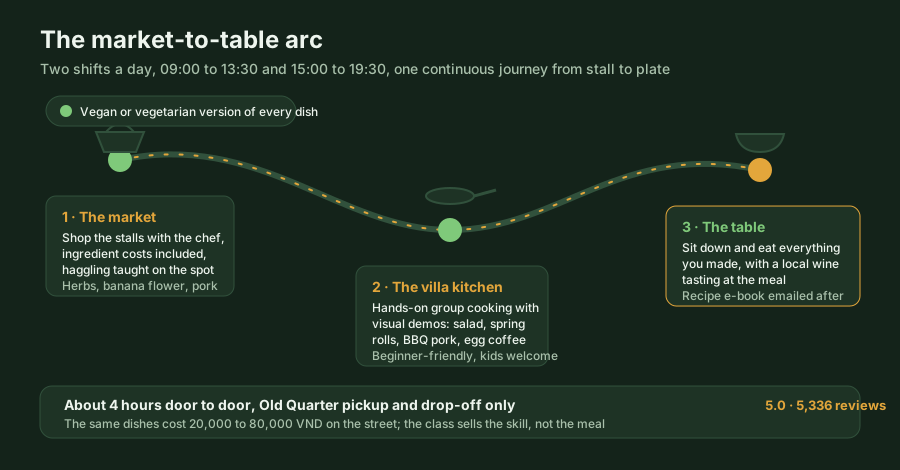
In two fixed shifts. Rose Kitchen operates 09:00 to 13:30 and 15:00 to 19:30 daily, and the listing's agenda runs market shopping first, then group cooking in the villa kitchen, then a seated meal of everything you made, with pickup and drop-off limited to Old Quarter addresses.
| Stage | What happens |
|---|---|
| Pickup | From Old Quarter locations only, per the listing |
| Market | Shopping the stalls; ingredient costs included, haggling taught |
| Villa kitchen | Hands-on group cooking, chefs demonstrating visually |
| The table | Sit down and eat your own work; local wine tasting, beer or soft drinks |
| Afterwards | Return transfer, and a recipe e-book emailed to you |
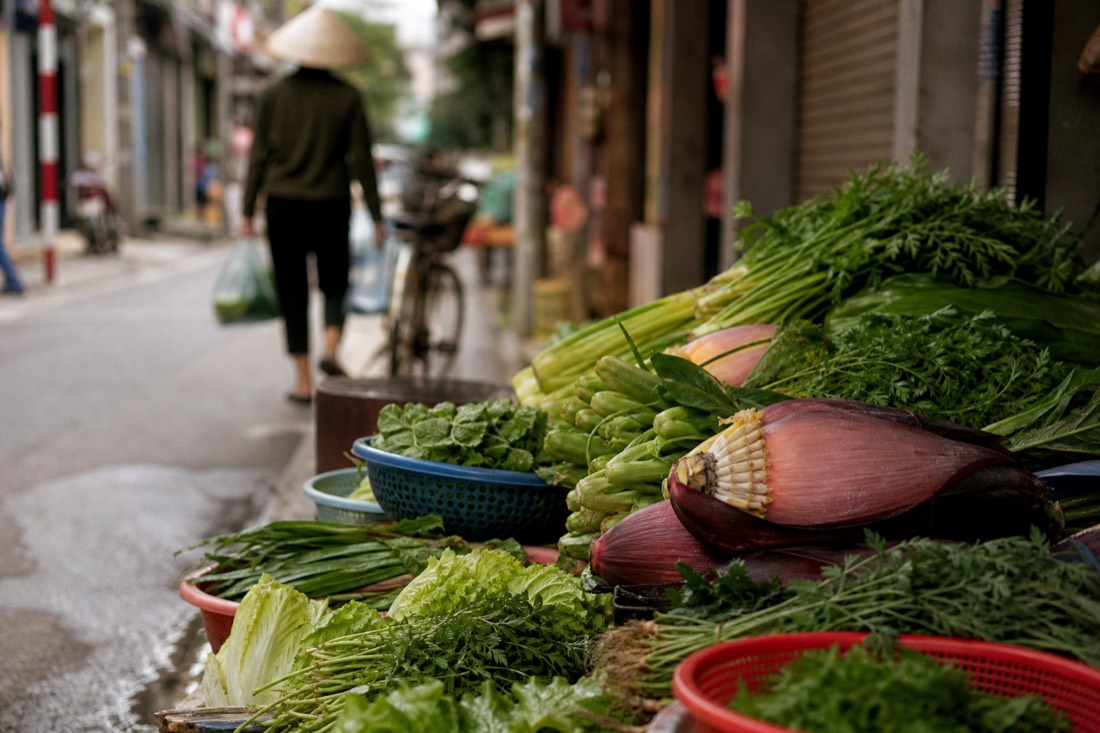
Foreigners assume the market will be the warm-up act before the real lesson. My guests consistently report the opposite: the market is the lesson, and the stove just confirms it. The market leg is the part I can speak to first-hand, because it is my own morning routine in miniature. The class teaches you to haggle, which visitors find either terrifying or addictive, and covers the ingredient costs. Watch what the shopping basket collects for that menu and you are reading northern cooking's grammar: the banana flower for the salad, herbs in serious quantity, pork for the grill and the rolls, rice paper, the fish sauce and lime and sugar that will become the dipping sauce. None of it is exotic here. All of it has a best stall, and learning to spot the difference between a good herb bundle and a tired one is a genuinely portable skill. If you want to see the full-scale professional version of that market world, the one where restaurant Hanoi buys its day before sunrise, I wrote about it in my dawn wet market walk.
Haggling deserves its own sentence, because visitors overthink it. It is not combat; it is a short, smiling script with a known ending, and the vendors enjoy a foreigner who tries it far more than one who either overpays silently or argues over pennies. A class that teaches you the script is handing you a social key to every market in Vietnam.
One hygiene note I give every guest who plans to cook here: the raw herb plate is the soul of northern food and also the thing the CDC's food and water guidance flags for travellers, so a class kitchen that washes and handles herbs properly in front of you is teaching you the most useful food-safety lesson in Vietnam by demonstration.
Do you need to know how to cook?
No, and this is stated policy rather than politeness. Rose Kitchen's chefs demonstrate every technique visually with simple instructions, the class is explicitly beginner-friendly, kids are welcome, and vegan or vegetarian versions exist for every dish on the menu. The people who struggle are usually the confident cooks, not the nervous ones.
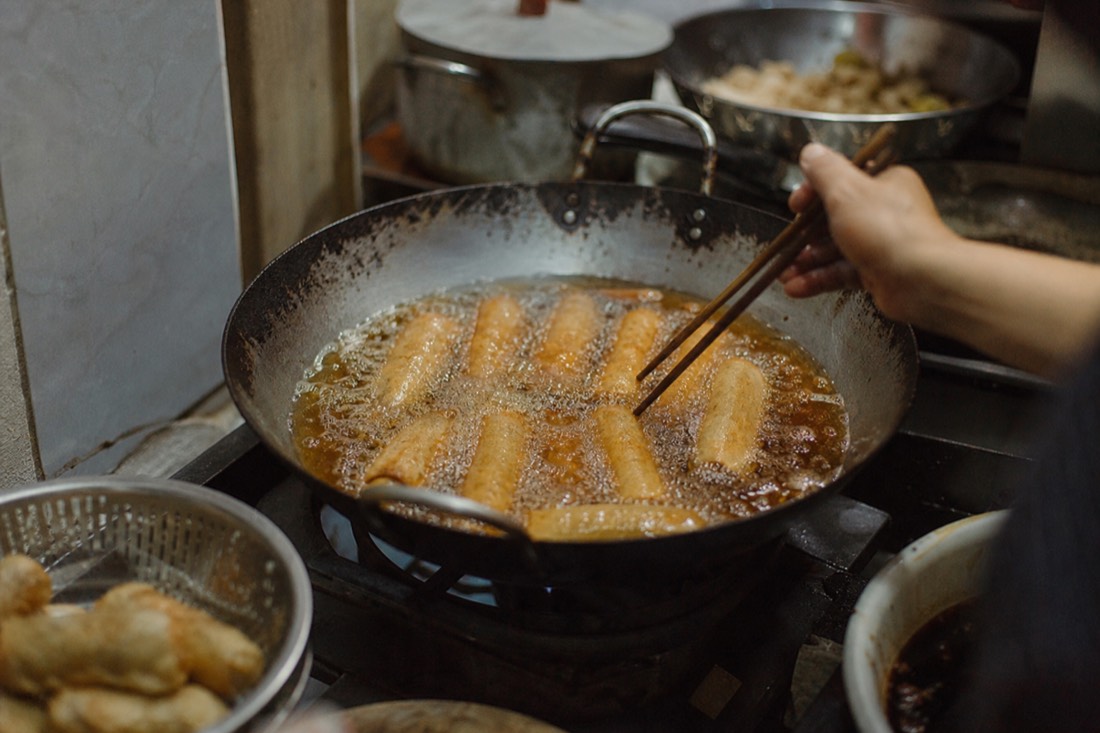
That last sentence is my observation, not the listing's, and I stand by it. The nervous beginners listen, copy the demonstration, and produce honest food. The kitchen-confident arrive mid-anecdote about their wok at home and fry their first spring roll at a temperature that would alarm a blacksmith. I have cooked beside both types at family tables my whole life, and the pattern holds across every nationality I have guided. Experienced Western cooks arrive with habits: high heat on everything, tasting nothing until the end, measuring instead of adjusting. Northern Vietnamese cooking works the opposite way. You taste the dipping sauce five times while building it. You treat fish sauce as a seasoning to be balanced, not a dare. You accept that the spring roll wants a gentle roll and a patient fry, and that rushing either shows up on the plate immediately.
What clicks, when it clicks, is the balance idea: sweet, sour, salty, bitter and hot adjusted against each other by taste, in real time. Guests come off the class and suddenly they can read menus. They know why the vegetarian versions swap in what they swap in. Half the canon of Hanoi dishes stops being exotic and becomes legible, which is the actual product a good class sells.
Is it cheaper to just eat these dishes on the street?
Vastly, and that is the wrong question. Street versions of everything on the class menu cost between 20,000 and 80,000 VND a dish, a few dollars at most. What a class sells is not the meal but the ability to reproduce it at home, plus a market walked with someone who can name every leaf on the herb table.
| The dish, eaten on the street | 2026 price (VND) |
|---|---|
| Bun cha (the grilled pork and vermicelli family) | 40,000 to 80,000 |
| Pho, the breakfast baseline | 40,000 to 60,000 |
| Banh mi | 20,000 to 40,000 |
| Egg coffee | 30,000 to 45,000 |
So no one books a cooking class for value per calorie. You book it for the e-book of recipes that arrives by email afterwards, for the wine at the table, and for the moment three months later when you serve spring rolls at home that actually crackle. I hear about that moment constantly. Guests write to me months after a trip, and the messages are never about the famous sights; they are photographs of home-rolled spring rolls, some triumphant, some honestly tragic, all sent with pride. A meal ends when the plates clear. A recipe keeps paying out for years, which quietly makes the class one of the better purchases of a whole trip. On tipping your hosts and guides, the norm here is the same as for tour guides generally, appreciated but never demanded; the Vietnam tipping guide puts guide tips at around 100,000 to 200,000 VND for a day when you want to give one.
Which class should you book?
Here is the test I give guests who wonder whether a class is worth an afternoon of a short trip. Picture yourself at the herb table in the market. If you want someone to hand you the right bundle, any tour will do. If you want to be the person who picks the right bundle, and then goes home and does it again at your own stove for people you love, that is a cooking class, and there is no shortcut. I learned at my grandmother's elbow with a lifetime of afternoons. You get four hours, a patient chef, and an e-book. Honestly, it is a fair trade.
Your next Hanoi experience
Check your date before planning the rest of the day
Rose Kitchen market and cooking class
Shop at a local market, cook a selected Vietnamese menu and share the meal in a garden-villa kitchen.
Allow 4–4.5 hours depending on option. Menu choices vary; pho or bun cha must be selected. Check pickup option. Vegan menu available by arrangement.
An editorial starting point. Confirm your party’s requirements with the operator.
Choose a date to see scheduled departures. Final availability and price are confirmed on Viator.
No verified option fits those requirements. Adjust your choices or reset to explore the general recommendations.
Compare options, fit your schedule & check your budget
Rose Kitchen market and cooking class · 4.5h. Shop at a local market, cook a selected Vietnamese menu and share the meal in a garden-villa kitchen. Allow 4–4.5 hours depending on option. Menu choices vary; pho or bun cha must be selected. Check pickup option. Vegan menu available by arrangement.
Bread & Brew banh mi baking class · 4h. Knead the bread, prepare fillings and pickles, and make Vietnamese coffee with a home chef. Ingredients, equipment and recipes included; tofu filling offered. Meeting location supplied after booking. Wheat-based class; not gluten-free.